Showing posts with label Pop Culture. Show all posts

Thursday, 19 August 2010

Mongolia is Awesome: Blizzard vs. the Golden Horde

Some of you may be familiar with the gaming phenomenon “World of Warcraft,” or at the very least with the enlightening South Park episode about it. Part of the brilliance of WoW lies in the fact that people keep playing it, and keep paying for it. In addition to paying the regular price of the game, gamers have to pay $20 each month to stay connected to the World part of  Warcraft, and because the game is engineered to keep people playing, Blizzard makes millions from regular subscriptions, in addition to the money from selling the game.

But Orcs and Elves are no match for the Mongols. Apparently, in Mongolia, players just don’t have to pay the monthly subscription fee. Though they have to pay for the game (and a computer), apparently there is a nationwide hacked account that gives Mongolians access to the game for free. This was described to me as “an official Mongolian server” for WoW, but what exactly “official” entails was not made completely clear. Though I doubt that it’s official in the sense of government-sponsored, this is Mongolia, and the government could be just that Awesome.

Mongolia is Awesome: Names Edition

After Mongolia became the Mongolian People’s Republic in 1924, they renamed the capital “Ulaanbaatar Xot.” Ulaanbaatar is technically two words, and Ulaanbaatar Xot literally means “Red Hero City.” It’s named after Sükhbaatar, the national hero who led the independence movement against China. Because he led a communist revolution, he was dubbed the Red Hero, and the city was named after him.

But “baatar” occurs in names that don’t involve nationalist leaders, too. It’s commonly found in people’s names; I’ve met a “Chuluunbaatar” (Stone Hero) and at least three “Ganbaatars”; “gan,” like Bold, is a word for steel, so Ganbaatar means Steel Hero. (This country rocks.)

Although having a bunch of Heroes running around is pretty Awesome on its own, Sükhbaatar himself probably takes the cake for the best compound of Hero.”“Sükh” is Mongolian for ax, so Sükhbaatar is simply Ax-Hero. I like to think that this is the equivalent of “George Washington Flamethrower,” or a presidential candidate named “M16 DESTROYER.” Hell, I’d vote for him.

And the moral of this Names Edition? If you are Holding Out for a Hero, get on the next plane to Mongolia.

Monday, 9 August 2010

Mongolia is Awesome: Names Edition

I’ve mentioned illegal gold mining briefly before, but I didn’t include the most important detail of the movement. In some areas, illegal miners are referred to as “ninjas,” which is pretty cool, I guess. But why they are called ninjas launches this into some of the sheerest Awesomeness yet encountered.

You see, they often mine at night, and have to climb out with their great green bowls strapped to their backs. (The bowls/buckets are for panning, maybe?) Because of their resemblance to giant turtles, and their midnight activities, they were nicknamed (if you know where this is going, I love you) “Teenage Mutant Ninja Turtles” and called “ninjas” for short.

That’s right, the TMNT are real and operating in the outskirts of Mongolia. Does this make the mining companies Shredder?

 Mongols or Teenage Mutant Ninja Turtles? Does it matter?

Mongolian Connections: Wrestle for Your Ring!


I came to Mongolia to study folk literature, and though my research quickly took off down a different route (the “religious studies” route—go figure), still I uncovered some folk tales that are strikingly similar to our own. One myth that Mongolians seem very fond of repeating is about the traditional costumes wrestlers wear.

Wrestlers don’t wear a lot of clothing, just a pair of briefs, a pair of boots, and a bolero-like jacket called a “jodag” or “zodag.” It pretty much just has sleeves and a back, and then ties around the belly. The exact story of why the jodag has an open chest varies from teller to teller, but it always has to do with a successful female wrestler. The most popular tale says that the costumes used to be full jackets, and at one festival, a mysterious wrestler defeated all the other wrestlers, and after receiving his reward (or after the final victory), he ripped open his jacket to reveal that he was indeed she. From that point on, jackets had to have the chest exposed so that women would no longer be able to compete. Another version says that Khutulun, a niece of Kublai Khan, challenged any suitors to a wrestling match. If she won, he had to give her 100 horses, but if he won, he could marry her. Supposedly she beat enough suitors to win 10,000 horses, and no man was ever able to defeat her so she remained single forever. Though I’ve heard that legend end with, “and since that time, women have not been allowed to wrestle, which is why men wear open-chested jackets,” I fail to see how one (Princess Khutulun) leads to the other (open-chested jackets), and I think two separate Mongolian girl-wrestler stories were merged into that one.

The idea of a woman defeating all the men isn’t confined to Mongolia—the first that comes to mind is the Greek tale of Atalanta, a young girl who beat all her suitors in footraces until one won through trickery. One Celtic myth tells the story of Macha, a woman who was able to run faster than the king’s fastest horses, and who gave birth during a race. The Iliad relates that Penthesilea defeated several heroes in battle before being killed by Achilles, the greatest Greek warrior. I’m sure there are tons of other stories like this, and they are just on the back of my mind, but I can’t quite remember them.

So this got me thinking—why do these stories exist and persist? Why are they so popular? Most of them probably were written by men, or at least recorded and handed down by men... So why did men delight in stories featuring women’s superiority over some men? Woolf, in A Room of One’s Own, points out that the same men who were demanding quiet and meek daughters and wives in real life were exalting heroines like Antigone or Rosalind in their literary works. And this is true in the legends, too—men liked being in power, demanded to be in power, yet read and re-told stories in which women were often the victors. What factors are at work here? Is it that these men, though they, for practical necessity, had to keep women under their power, truly wanted or admired strong heroines and thus put them in their poetry? Or is it the other way around—that though they fantasized that women could have power, the fantasy was best (for them) left as a fantasy, and they didn’t appreciate the reality of powerful women? (Is that even the other way around, or is it the same exact thing?)

But there are also cultural differences at work in these stories. Atalanta did eventually lose her race, and Penthesilea was killed by a man. (For Macha, the Celtic heroine, the story gets much more complicated.)  And not all stories of strong heroines are positive—Look at Lady MacBeth as a classic example, or many portrayals of Cleopatra. (Especially Roman portrayals of Cleopatra versus Octavia; though the reasons for hating one and loving the other might be political, which traits did they emphasize in each? Also, Horace's Ode 1.37 has a portrayal of Cleopatra that fits well into this post's theme of whether men admire or resent real powerful women.) Do the men who passed on these stories use them actually as catharsis, as a way to keep women down even in legends? That is, writing/reading the stories not as “Atalanta/ Penthesilea defeated many men,” but as “even the best woman Atalanta/ Penthesilea could eventually be brought down by a man.” In contrast, the Mongolian legend never has that moment of “But wait! She couldn’t beat all the men!” In fact, the legend of the jorba can be read as one that says that Mongol men still believe a female wrestler might be able to best them; thus they need to keep women out of the ring. This might reflect Mongol attitudes toward women generally; women had a lot of power, from Genghis Khaan’s wife in The Secret History of the Mongols to later queens who ruled when their alcoholic husbands or young sons could not. Marco Polo reported that women were trained as warriors, and though they no longer wrestle, girls are still allowed to compete in archery and horseback riding during Naadam. (There will be a later post, hopefully, about the Awesomeness of Mongolian women.) And there doesn’t seem to be any backlash against this, at least not that I’ve encountered.

What makes the difference here? Mongolia was traditionally a patriarchal society, just like most others, so why do its myths and history reflect more respect for women? Do its myths and history even reflect more respect for women, or am I reading them wrong? What is the relationship between attitudes toward women and women in myth? And finally—what do our myths say about women? (When I say “our myths,” take this however you like, from your religion to your culture to the movies you watch and show your children.) Disney’s Mulan might be an admirable girl, but she impressed her captain and defeated the Huns (who came, by the way, from Mongolia) through ingenuity, not through strength. (Though you'll need both to reach the arrow...) On the other hand, Disney’s Nala ceded to Simba’s authority as king, but she could still always pin him, and it was her advice sent him back to defeat Scar. (So now we know what I consider my mythology.)


You could apply these analyses to many women admired by our society, and look at which religious stories we choose to emphasize (Noah and David get a lot of press-Miriam, Deborah, and Jael? Not so much), which historical figures we exalt, even which celebrities we admire, and, just as importantly, what we admire them for. So how do we stack up? What sorts of girls are we looking back at, and thus, what sorts of girls are we bringing forth?

Friday, 23 July 2010

Mongolia is Awesome: Even Before There Were People

The Gobi desert in the south of Mongolia is a paleontologist’s paradise; for whatever reasons (the heat, its aridity, and the previous creature populations, I’m guessing), the Gobi is a treasure trove of fossils. Rare finds like a pair of fighting dinosaurs and a dino-mommy hunched over her eggs were unearthed in the Gobi, most likely the result of dune collapses or sudden sandstorms. In 2006, paleontologists found 67 dinosaur skeletons in one week (which sounds like a lot to me), and many new species of dinosaurs or other ancient creatures have been discovered in Mongolia, such as this “giant parrot” dinosaur. (Personal Note: I will be in the Gobi, probably seeing a fossil or two, in a couple weeks!)

All of that is awesome, but it’s not quite Mongolia-level Awesome yet. That’s because I’ve left the kickers for the end. The only example of the skull of the Andrewsarchus was discovered in Mongolia by Roy Chapman Andrews (he’s kind of a big deal) in 1923. (Well, that’s not quite true; it was discovered by Kan Cheun Pao, a member of Andrews’s team who does not even have his own Wikipedia page. Something about that scenario seems so typical.) The Andrewsarchus is pretty freaking Awesome, and even before I got to Mongolia, I was hoping to meet one of these bad boys. Note that the BBC describes it as “the largest carnivorous land mammal ever.” Apparently their show “Walking with Beasts” also called it the “Whale-Killer” and featured a clip of two of them hunting whales. Although the BBC has maybe taken a few liberties with the information that can actually be gleaned from a piece of skull, it can’t be denied that a giant roaming carnivore with jaws that can crush bone and a silhouette like a werewolf is Awesome. And the moral of this story is that I have to find fossils of the coolest dinosaur ever and name it the ALICEOSAURUS KHAAN.

Though this was meant to be a post just about the Andrewsarchus, in my research I came across something even more Awesome about Mongolia. Maybe you have heard of velociraptors, just about the scariest and most intense dinosaurs ever, according to XKCD (my paleontological authority). They are the primary villiains in Jurassic Park, and since then they have been immortalized in popular culture and a meme or two. And you know where this is going…

All velociraptor fossils ever discovered have been found in Mongolia (Inner and Outer), and the official name of the main velociraptor species is “Velociraptor Mongoliensis.” That’s right: Steven Spielberg owes Mongolia big time.

Saturday, 3 July 2010

Mongolia is Relevant: Why Natalie Portman Thinks You Should Learn About Mongolia

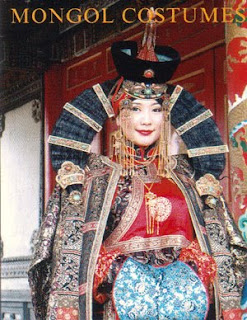
Images of traditionally dressed upper-class Mongolian women are scattered through UB City in ads or postcards. Check out these pictures of the traditional costumes of Mongolian women:


Look familiar? That’s because George Lucas used the outfits of Mongolian queens as the source for one of Queen Amidala’s costumes. Although it pains me that this now means that a pic of Amidala shows up as the first GoogleImage result for “Mongolian traditional dress,” using historical Mongolian dress as inspiration is still pretty cool.


Who knew there was such a direct link between Mongolia and Natalie Portman?