Showing posts with label Mongolia is Relevant. Show all posts

Thursday, 19 August 2010

Mongolia is Relevant: What Might Have Been

Okay, okay, I have a confession. Technically, my “Mongolia is Relevant” posts are a bit self-defeating, because if it were really relevant, you wouldn’t need me to tell you that. A blog on the USA doesn’t need to detail why it’s powerful, and a blog on China won’t bother to list the ways Chinese products impact your life. We’re aware that the US and China (and countless other countries) are relevant, because they are just so relevant. Mongolia impacts history and culture in a lot of ways, but it hasn’t impacted our world in a substantial enough way that the average Joe knows it.

But I’m here to tell you how close Mongolia was to being unquestionably, unignorably relevant. One of the books I read in my research is the story of Rabban Sauma, a Nestorian monk sent as an envoy from the Ilkhan to Europe at the end of the 13th Century. Rabban Sauma visited the Pope, the King of France, and the King of England, asking them to unite with the Mongols in an assault against the Mamluks. If European forces initiated another Crusade against the Muslim Mamluks in Egypt at the same time that the Mongols attacked from the East, the Mamluks would have been overwhelmed and defeated. Thus Mamluk assaults both on Christian Outremer communities and on the Mongol Ilkhanate would have been drastically reduced, and the Ilkhan promised to present Jerusalem to the Christians.

But this was not to be; while the Ilkhanate was desperately defending itself against the Mamluks, Europe was plagued by internal conflict, both between and within individual countries. Furthermore, parts of Europe (*coughcough GENOA coughcough*) were enjoying lucrative trade with the Muslims, and weren’t  eager to give up that income. So the alliance never happened, the present Ilkhan died, and his successors mostly converted to Islam. The historian Sir Steven Runciman expressed the potential significance of the alliance thusly:
“Had the Mongol alliance been achieved and honestly implemented by the West, the existence of Outremer would almost certainly have been prolonged. The Mamluks would have been crippled if not destroyed; and the Ilkhanate of Persia would have survived as a power friendly to the Christians and the West.”

So that whole Middle East tension thing? It might have been reduced (though probably never eliminated) years ago. Or, it could have been exacerbated, and maybe there might not have been a Dome of the Rock to fight over. But it would certainly have been different. And if the Mongols had exerted more control over the Middle East, they might still be in the Middle East, instead of confined mostly to Northern China, Outer Mongolia, and enclaves in New Jersey. I don’t know much about history, but this alliance would have been a big deal.

It may not have ended there… It would have been nice if the “Ilkhanate of Persia would have survived as a power friendly to Christians and the West,” but that wasn’t inevitable. Early European reluctance to an alliance with the Mongol Empire was based on the fear that the Mongol Empire, having conquered the lands to the east of Europe, would have seeped further into Europe itself. Though by the end of the 13th Century, the Mongols no longer retained their former power, this could have been a possibility. Once the Mamluks were defeated, the Mongol Horde’s total war may have been unleashed on the lands of their former allies, and, as the clichĂ© goes, we might all be speaking Mongolian. (Though the US certainly wouldn’t have been founded under the circumstances it was, so you and I probably just wouldn’t be here, period.) Now, the Europe-Mongol alliance wasn’t exactly close to happening; a lot of factors prevented it, and there would have been more obstacles to a Mongol occupation of Europe… But it was possible.

So sure, Mongolia’s pretty remote now, but you should know that it could have ended up right in your backyard.

Monday, 9 August 2010

Mongolian Connections: Wrestle for Your Ring!


I came to Mongolia to study folk literature, and though my research quickly took off down a different route (the “religious studies” route—go figure), still I uncovered some folk tales that are strikingly similar to our own. One myth that Mongolians seem very fond of repeating is about the traditional costumes wrestlers wear.

Wrestlers don’t wear a lot of clothing, just a pair of briefs, a pair of boots, and a bolero-like jacket called a “jodag” or “zodag.” It pretty much just has sleeves and a back, and then ties around the belly. The exact story of why the jodag has an open chest varies from teller to teller, but it always has to do with a successful female wrestler. The most popular tale says that the costumes used to be full jackets, and at one festival, a mysterious wrestler defeated all the other wrestlers, and after receiving his reward (or after the final victory), he ripped open his jacket to reveal that he was indeed she. From that point on, jackets had to have the chest exposed so that women would no longer be able to compete. Another version says that Khutulun, a niece of Kublai Khan, challenged any suitors to a wrestling match. If she won, he had to give her 100 horses, but if he won, he could marry her. Supposedly she beat enough suitors to win 10,000 horses, and no man was ever able to defeat her so she remained single forever. Though I’ve heard that legend end with, “and since that time, women have not been allowed to wrestle, which is why men wear open-chested jackets,” I fail to see how one (Princess Khutulun) leads to the other (open-chested jackets), and I think two separate Mongolian girl-wrestler stories were merged into that one.

The idea of a woman defeating all the men isn’t confined to Mongolia—the first that comes to mind is the Greek tale of Atalanta, a young girl who beat all her suitors in footraces until one won through trickery. One Celtic myth tells the story of Macha, a woman who was able to run faster than the king’s fastest horses, and who gave birth during a race. The Iliad relates that Penthesilea defeated several heroes in battle before being killed by Achilles, the greatest Greek warrior. I’m sure there are tons of other stories like this, and they are just on the back of my mind, but I can’t quite remember them.

So this got me thinking—why do these stories exist and persist? Why are they so popular? Most of them probably were written by men, or at least recorded and handed down by men... So why did men delight in stories featuring women’s superiority over some men? Woolf, in A Room of One’s Own, points out that the same men who were demanding quiet and meek daughters and wives in real life were exalting heroines like Antigone or Rosalind in their literary works. And this is true in the legends, too—men liked being in power, demanded to be in power, yet read and re-told stories in which women were often the victors. What factors are at work here? Is it that these men, though they, for practical necessity, had to keep women under their power, truly wanted or admired strong heroines and thus put them in their poetry? Or is it the other way around—that though they fantasized that women could have power, the fantasy was best (for them) left as a fantasy, and they didn’t appreciate the reality of powerful women? (Is that even the other way around, or is it the same exact thing?)

But there are also cultural differences at work in these stories. Atalanta did eventually lose her race, and Penthesilea was killed by a man. (For Macha, the Celtic heroine, the story gets much more complicated.)  And not all stories of strong heroines are positive—Look at Lady MacBeth as a classic example, or many portrayals of Cleopatra. (Especially Roman portrayals of Cleopatra versus Octavia; though the reasons for hating one and loving the other might be political, which traits did they emphasize in each? Also, Horace's Ode 1.37 has a portrayal of Cleopatra that fits well into this post's theme of whether men admire or resent real powerful women.) Do the men who passed on these stories use them actually as catharsis, as a way to keep women down even in legends? That is, writing/reading the stories not as “Atalanta/ Penthesilea defeated many men,” but as “even the best woman Atalanta/ Penthesilea could eventually be brought down by a man.” In contrast, the Mongolian legend never has that moment of “But wait! She couldn’t beat all the men!” In fact, the legend of the jorba can be read as one that says that Mongol men still believe a female wrestler might be able to best them; thus they need to keep women out of the ring. This might reflect Mongol attitudes toward women generally; women had a lot of power, from Genghis Khaan’s wife in The Secret History of the Mongols to later queens who ruled when their alcoholic husbands or young sons could not. Marco Polo reported that women were trained as warriors, and though they no longer wrestle, girls are still allowed to compete in archery and horseback riding during Naadam. (There will be a later post, hopefully, about the Awesomeness of Mongolian women.) And there doesn’t seem to be any backlash against this, at least not that I’ve encountered.

What makes the difference here? Mongolia was traditionally a patriarchal society, just like most others, so why do its myths and history reflect more respect for women? Do its myths and history even reflect more respect for women, or am I reading them wrong? What is the relationship between attitudes toward women and women in myth? And finally—what do our myths say about women? (When I say “our myths,” take this however you like, from your religion to your culture to the movies you watch and show your children.) Disney’s Mulan might be an admirable girl, but she impressed her captain and defeated the Huns (who came, by the way, from Mongolia) through ingenuity, not through strength. (Though you'll need both to reach the arrow...) On the other hand, Disney’s Nala ceded to Simba’s authority as king, but she could still always pin him, and it was her advice sent him back to defeat Scar. (So now we know what I consider my mythology.)


You could apply these analyses to many women admired by our society, and look at which religious stories we choose to emphasize (Noah and David get a lot of press-Miriam, Deborah, and Jael? Not so much), which historical figures we exalt, even which celebrities we admire, and, just as importantly, what we admire them for. So how do we stack up? What sorts of girls are we looking back at, and thus, what sorts of girls are we bringing forth?

Tuesday, 27 July 2010

Mongolia is Relevant: Mongolia and Your Mobile

I finally managed to find a copy of the English-Language newspaper in Mongolia, and immediately a few things struck me. One was how much was about economics—there was a “Money” section AND a “Market” section, plus the front page had an money/market focus. But a lot of the economic issues are related to the big thing in Mongolia these days: Mining.

Companies are rushing to develop infrastructure to tap the rich resources of the (till now) untouched Mongolian countryside. Though Mongolia’s not currently a huge player on the international market, that’s partially because it just doesn’t have the equipment and railroads (and regular roads) to uncover all its natural resources.

And valuable resources they are… though cashmere is my personal favorite, Mongolia also has mines upon mines of coal, copper, gold, and (my second favorite) uranium. One article I read was about the development of a new railway to Tavan Tolgol, “one of the largest coal deposits in the world.” But much of Mongolia’s earnings come from the Erdenet open-face copper mine, one of the ten largest copper mines in the world; it produces around 25 million tons of ore yearly, and because most of that goes to China, you’ve undoubtedly come into contact with some Erdenet copper (in your electronics) without even knowing it. On a more adventurous note, there are several Gold Rushes taking place in Mongolia right now, with people flocking to certain areas to illegally mine gold there. And unlike our Gold Rushes, there’s actually enough gold to provide most miners with substantial income. (They’re not getting rich, exactly, but they’re getting fed.) Though right now this mining is unregulated and dangerous, the government is working to extract the gold systematically and safely (though likely at the expense of the beautiful surroundings).

And onto the uranium! As I discovered in an article about Mongolia’s attempts to shift to nuclear power, Mongolia has 63,000 tons of proven uranium reserves, and it is estimated to have up to 100,000 tons. Just the proven reserves account for 2% of the entire world’s reserves, so it could potentially have 3 or 4%.

So though Mongolia may seem remote now, bear in mind that its resources are already relevant to your life, and probably the relevance of Mongolia’s mines will be impossible to ignore in a few decades. Oh, and also the cashmere—try ignoring that.

Friday, 23 July 2010

Mongolia is Awesome: Even Before There Were People

The Gobi desert in the south of Mongolia is a paleontologist’s paradise; for whatever reasons (the heat, its aridity, and the previous creature populations, I’m guessing), the Gobi is a treasure trove of fossils. Rare finds like a pair of fighting dinosaurs and a dino-mommy hunched over her eggs were unearthed in the Gobi, most likely the result of dune collapses or sudden sandstorms. In 2006, paleontologists found 67 dinosaur skeletons in one week (which sounds like a lot to me), and many new species of dinosaurs or other ancient creatures have been discovered in Mongolia, such as this “giant parrot” dinosaur. (Personal Note: I will be in the Gobi, probably seeing a fossil or two, in a couple weeks!)

All of that is awesome, but it’s not quite Mongolia-level Awesome yet. That’s because I’ve left the kickers for the end. The only example of the skull of the Andrewsarchus was discovered in Mongolia by Roy Chapman Andrews (he’s kind of a big deal) in 1923. (Well, that’s not quite true; it was discovered by Kan Cheun Pao, a member of Andrews’s team who does not even have his own Wikipedia page. Something about that scenario seems so typical.) The Andrewsarchus is pretty freaking Awesome, and even before I got to Mongolia, I was hoping to meet one of these bad boys. Note that the BBC describes it as “the largest carnivorous land mammal ever.” Apparently their show “Walking with Beasts” also called it the “Whale-Killer” and featured a clip of two of them hunting whales. Although the BBC has maybe taken a few liberties with the information that can actually be gleaned from a piece of skull, it can’t be denied that a giant roaming carnivore with jaws that can crush bone and a silhouette like a werewolf is Awesome. And the moral of this story is that I have to find fossils of the coolest dinosaur ever and name it the ALICEOSAURUS KHAAN.

Though this was meant to be a post just about the Andrewsarchus, in my research I came across something even more Awesome about Mongolia. Maybe you have heard of velociraptors, just about the scariest and most intense dinosaurs ever, according to XKCD (my paleontological authority). They are the primary villiains in Jurassic Park, and since then they have been immortalized in popular culture and a meme or two. And you know where this is going…

All velociraptor fossils ever discovered have been found in Mongolia (Inner and Outer), and the official name of the main velociraptor species is “Velociraptor Mongoliensis.” That’s right: Steven Spielberg owes Mongolia big time.

Tuesday, 20 July 2010

Mongolia is Relevant: Xanadu

Like Timbuktu and Arcadia, Xanadu is familiar as a semi-mythical place name used symbolically. Just as Timbuktu is synonymous with remoteness, Xanadu conjures images of exotic opulence, excess, and transient pleasure. Made famous by a Coleridge poem, the idea of “Xanadu” took on a life of its own; it is the name of Kane’s castle in Citizen Kane and the title of a fantasy film from the eighties featuring Olivia Newton-John. So what exactly is Xanadu? Is it a real place? And how did it come to be associated with party estates and nightclubs?


Like so many things in life, it all comes back to the Mongols. I encountered the world “Xanadu” here much more than I have in US; there’s a Xanadu bookshop (that, mysteriously, is also a wine shop), a gallery, and I think a cafĂ©/restaurant or two. So what does Mongolia have to do with Xanadu? Xanadu is the European term for Shangdu, the summer capital of Kublai Khan. When he wasn’t busy ruling most of China and trying to juggle defeating his enemies with making (and conquering) new ones, Kublai needed to unwind, and according to Marco Polo, Shangdu was the place to do it. Polo described the acres of gardens, filled with streams, pastures, and animals for hunting, as well as a gilded palace that was completely moveable (like a giant golden ger). Samuel Taylor Coleridge took the image to new heights with his poem “Kubla Khan,” an elaborate fictionalized description of Xanadu that Coleridge wrote after he dreamt of the Khan in his gardens. (Opium was involved.) So although our image of Xanadu of a paradise of pleasure might not be completely true to life, the excess of the Mongols has been enshrined by Europeans in the implications of the single word “Xanadu,” and this term has evolved to describe the excess of the West as well.

But if Kublai’s cool summer capital was Shangdu, where did he spend his winters? In his carefully planned “grand capital” Tai-Tu. He moved his administrative capital from Karakorum down to what is now part of China; no one knows why exactly the capital was moved, though scholars speculate that it may have been to keep better tabs on the Chinese part of his empire. And what now stands on the ruins of Tai-tu? Beijing, the current capital of China.

So a Mongol is responsible for the a fictionalized image of paradise (Xanadu), and for what is not only still a real city, but also still a pretty significant city.

Saturday, 3 July 2010

Mongolia is Relevant: Why Natalie Portman Thinks You Should Learn About Mongolia

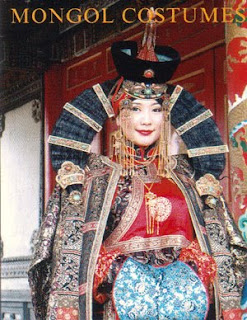
Images of traditionally dressed upper-class Mongolian women are scattered through UB City in ads or postcards. Check out these pictures of the traditional costumes of Mongolian women:


Look familiar? That’s because George Lucas used the outfits of Mongolian queens as the source for one of Queen Amidala’s costumes. Although it pains me that this now means that a pic of Amidala shows up as the first GoogleImage result for “Mongolian traditional dress,” using historical Mongolian dress as inspiration is still pretty cool.


Who knew there was such a direct link between Mongolia and Natalie Portman?

Monday, 28 June 2010

Mongolia is Relevant: The Dalai Lama

Perhaps you have heard of the Dalai Lama. He’s kind of a big deal. The word “lama” is the word for a high-ranking Buddhist monk; it’s Tibetan in origin, but it is used here (though technically incorrectly) interchangeably with "monk." So when you go to a monastery, you can refer to the men there (all in red, with orange sashes) as either monks or lamas. (In one amusing typo on a museum plaque, a great “llama” had bestowed a gift on the temple. I immediately thought of The Emperor’s New Groove.) 

So that’s what the “Lama” in Dalai Lama means—but what about “Dalai”? It’s not Tibetan, but is the Mongolian word for “Ocean.” In the sixteenth century, Altan Khan, a ruler in Mongolia, bestowed the title of “Dalai Lama” on Sonyam Gyatso, the first person to receive it. (Two other Dalai Lamas were retroactively declared, making Sonyam Gyatso the third official Dalai Lama.) Thus, the most powerful living man in Tibetan Buddhism owes his title to a Mongol Khan, centuries after Genghis’s reign.

The Tibetans tend to refute this legend, saying that “Dalai Lama” was a Mongolian translation of a term already in use in Tibet, and that “Gyatso” (Tibetan for “ocean”) was used in titles before the Mongols applied “Dalai” to “Lama.” However, Mongolia legendarily thinks of itself as an ocean, (because of its vastness), and Genghis Khan means “Ocean King.” Genghis took this title after he had united all the Mongol people and had finally become ruler of the whole “ocean,” that is, Mongolia. 

(Definitely Ocean.)

Tibet and Mongolia are both landlocked, but one has a literary tradition of using the “ocean” as a symbol of significance, and historical precedence in using “ocean” as a person’s title. So, whatever the direct linguistic lineage of “Dalai Lama” is, I’m thinking the influence was very much Mongol. So you’ve been mentioning a Mongolian tradition for years and haven’t known it.

 Rajat and the Dalai Lama are tight.

Tuesday, 22 June 2010

Mongolia is Relevant: Our Lady of the Mongols


I found out I’d be spending the summer in Mongolia just before I went to Istanbul. I was initially interested in two (very broad) aspects of Mongolian society—nomadic culture and traditional literature, and modern Mongolia’s development—and didn’t know much about the Mongol Empire. It was something that pushed on the fringes of what I studied, but rarely explicitly intersected with it, at least in what I read (mostly European/American texts). So it was a bit of a joy to encounter in Istanbul the character “Mary of the Mongols.” Mary was so nicknamed because she married a Mongol khan, after his father (her original betrothed) died. When that husband was assassinated by his brother, the brother also wanted to marry Mary, so she fled back to her father (an Emperor), who then planned to marry her off to a different Mongol khan (the fourth in this story). Instead, Mary joined a convent and gave enough money to rebuild the nunnery and attach a church. In honor of her, the church is referred to as the Church of St. Mary of the Mongols, and she is affectionately termed “Our Lady of the Mongols.” She also donated money to help build/decorate Christ Chora, (or I think she did—she was certainly featured in the mosaics there along with other benefactors).


So I heard about this woman and her churches and discovered, for the first time, Mongolia making an impact in a tangible and permanent way, only days after discovering that Mongolia would be making an impact on me in a tangible and permanent way. We (myself included) tend to reduce the image of Mongolia to some remote steppe and desert, whose empire was as brief as it was massive. But that’s just not true, as a little bit of Mongolian-history sleuthing will show you. For a while, Mongolia was there, not only pressing at the edges of the world, but slipping into and out of it and leaving their mark all over the continent. They may not have constructed many extant buildings, and Genghis Khaan may not have left much documentation, but as Our Lady of the Mongols demonstrates: Mongolia is relevant.